
Organ-on-a-chip technology lets researchers test medicines on living human tissue instead of animals — and since 2022, US law no longer forces the animal detour. But every commercial platform answers the same general question. PepStemChip, invented by Bogdan Dicoias at Panacea Bio Chem, is the organ-chip designed around the two classes of medicine that never got their own testbed: peptides and stem cells.
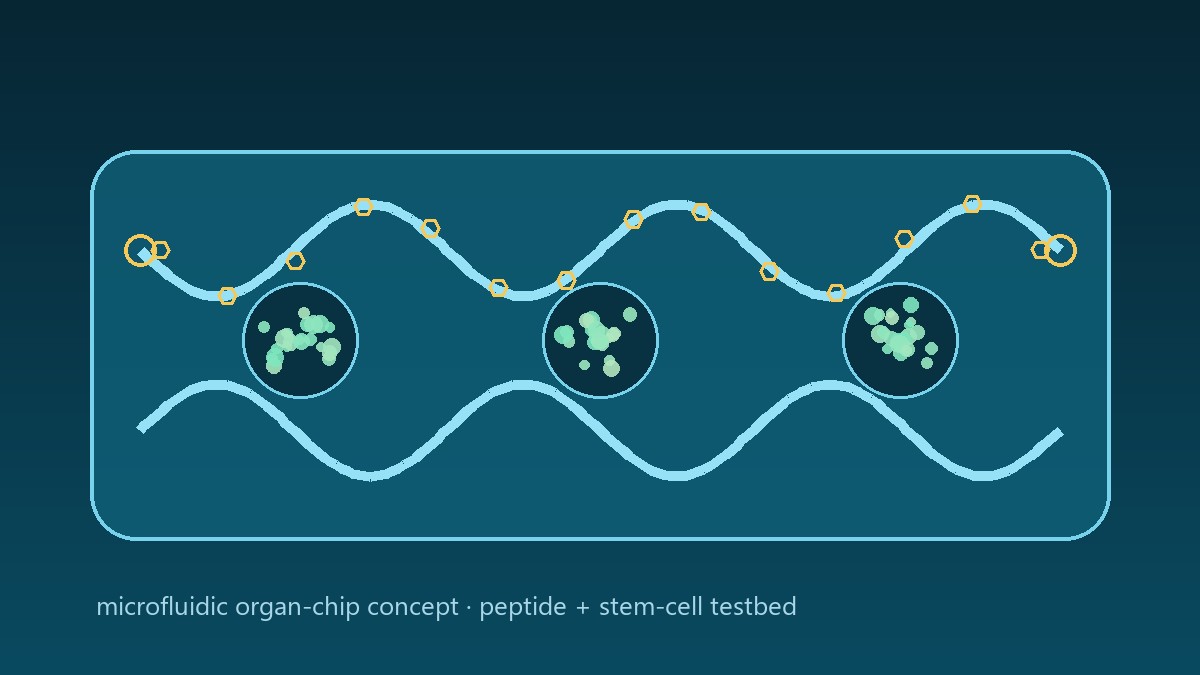
Take a transparent slab the size of a USB stick, etch hair-width channels into it, and line those channels with living human cells. Push fluid through like blood, stretch it like breathing tissue, keep two cell types talking across a membrane. What you get is not a model of an organ on a computer — it is a working piece of organ-level biology you can hold in your hand.
The landmark 2010 lung-on-a-chip from Donald Ingber's group at Harvard's Wyss Institute reproduced the alveolar–capillary interface — air on one side, blood-like flow on the other, and the mechanical rhythm of breathing itself. Cells behaved like lung because the chip made them live like lung.
Cells in a flat plastic dish experience no flow, no stretch, no gradients — an existence no real tissue knows. Chips restore the physical cues, and with them, tissue-level behaviour: barrier function, immune responses, realistic drug metabolism.
Chips carry human cells, so results are not filtered through a rodent's metabolism. That matters most exactly where drugs fail: species-specific toxicity and efficacy that animal studies miss.
The FDA Modernization Act 2.0 (December 2022) ended the blanket mandate for animal testing before human trials, opening the door for organ-chip data in drug applications. In April 2025 the FDA published a roadmap to reduce animal testing — naming organ-chips among the replacement methods.
Roughly nine out of ten drug candidates that enter human trials after passing animal studies never reach patients. The chip field exists because of that number.
Peptides are the fastest-growing class in modern drug discovery, and stem-cell therapies are medicine's longest-standing promise. Both are tested today on platforms designed for neither.
A peptide can be degraded by enzymes in minutes, bind its receptor with nanometre precision, and behave differently under flow than in a static well. Generic organ-chips were engineered around small-molecule ADME questions, not around the life cycle of a peptide.
A stem-cell culture is not a reagent — it expands, competes, drifts and differentiates. Testing what a peptide does to a stem-cell population requires a platform where the cells' environment is controlled hour by hour and observed continuously, not sampled destructively.
Peptide fate and stem-cell fate are decided in the same place: a living micro-environment with flow, mechanics and gradients. Whoever builds a chip for one has built most of a chip for the other.
Survey the commercial organ-chip catalogues and you will find liver, lung, gut, kidney, brain and tumour models. We are not aware of any commercially available organ-chip platform designed specifically around peptide testing, or around the peptide–stem-cell interplay. That is the shelf PepStemChip occupies.
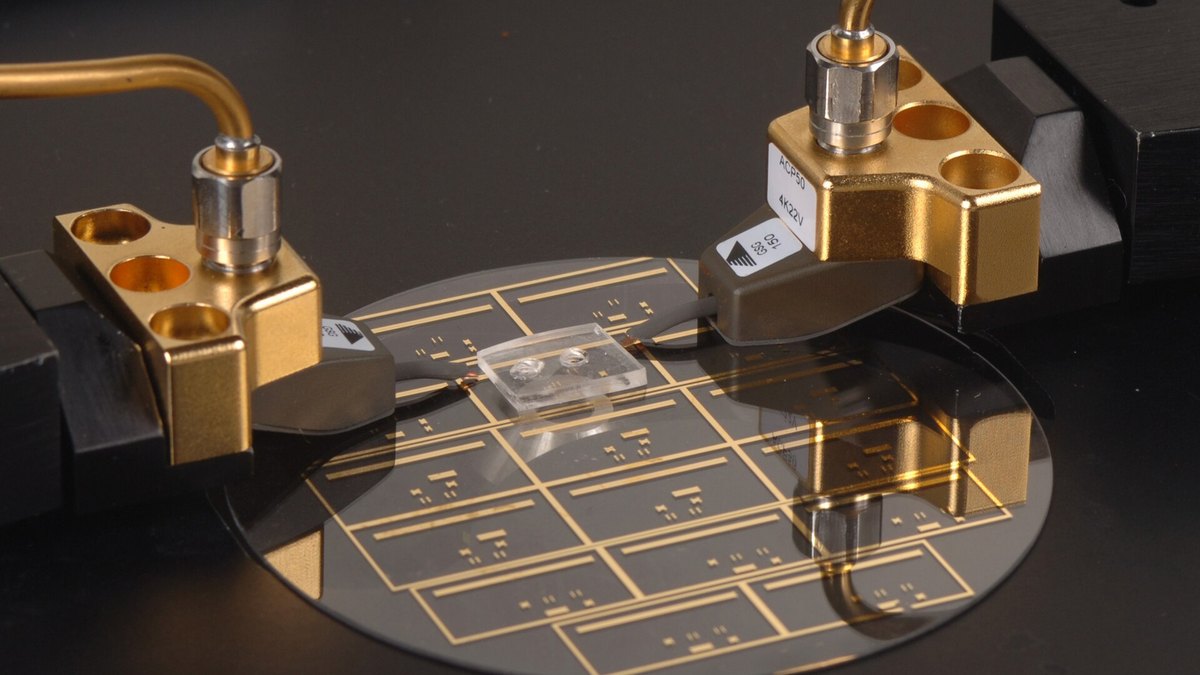
Panacea Bio Chem works where peptides and living cells meet — amino-acid-chain design, formulation, lyophilization. PepStemChip is the organ-on-a-chip platform invented here by Bogdan Dicoias to close the gap above: a testbed engineered from the start around how peptides actually behave in living micro-environments, and around how stem cells respond to them over time — so a candidate chain meets realistic human biology before it ever meets an animal, let alone a person.
We are deliberately telling you the gap it fills, not the blueprint. The architecture, materials and operating parameters are Panacea intellectual property and will be disclosed with data, not adjectives — the same discipline our LyoLevit aerogel work follows. What we can say plainly: the platform exists, it is ours, and it is built for the two classes of medicine the chip revolution left standing at the door.
In-house platform · design disclosure follows peer review
"The chip pioneers taught cells to live like organs. Beautiful work — and entirely general. But a peptide does not need a generic organ; it needs the two minutes of flow, enzyme and receptor that decide whether it lives or dies. And a stem cell needs an address, not a dish. We built the testbed for the molecules and cells that everyone else asked to wait outside."
Bogdan Dicoias — Biochemist · AAC Designer · Panacea Bio Chem Ltd
This page positions a platform, so it carries an honest boundary. Everything stated about the organ-on-a-chip field above is public record, credited on The Research page with names and years. Everything stated about PepStemChip is a statement of purpose and scope — the design itself remains Panacea intellectual property until peer-reviewed publication, and no performance figures are claimed here.
The field's credited history, the regulatory shift that made organ-chip data count, the specific gap — no peptide-specific, no stem-cell-specific commercial testbed — and the fact that Panacea has built a platform to fill it.
Channel architecture, membrane and materials choices, actuation method, sensing stack and operating parameters. The gap is the story today; the blueprint will be the story after peer review.
A claim that a shelf is empty is only as good as the last time someone looked. So the claim at the centre of this page is kept as a dated ledger — each entry records what was searched, what was observed, and what would change our mind.
What a ledger entry does not mean: absence in one dated search is not proof of universal absence — a specialised startup could exist unindexed, and vendors may run peptide projects as custom services without productising a platform. What closes the ledger: any vendor productising a peptide-specific organ-chip. The day that appears, this page says so.
The regulatory door opened in two moves — one for drugs in general, one naming the methods. Neither was written with peptides in mind, which is precisely the opening.
The FDA Modernization Act 2.0 (S.5002, 117th Congress) removed the requirement that every drug be tested in animals before human trials, making data from new approach methodologies — organ-chips among them — admissible in support of applications. Admissible is not sufficient: the evidence still has to carry the application. S.5002 text (govinfo)
In April 2025 the FDA announced a plan to phase out the animal-testing requirement for monoclonal antibodies and other drugs, explicitly naming organ-on-a-chip systems among the human-relevant methods, with a pilot program as the entry point. Peptides are not the named frontier of that roadmap; guidance written for peptide-specific NAMs does not yet exist. FDA press announcement, April 2025
Regulatory writers generalise from the methods in front of them. The vendor layer builds general organ models, so the regulatory record is being written around general organ models. A platform designed around peptide fate — enzyme exposure, receptor binding, flow — is the kind of instrument the peptide chapter of NAMs will eventually need data from.
The FDA has not ended animal testing — the 2025 announcement is a plan with a defined first scope. Chip data does not yet replace animal data in general, and PepStemChip has submitted nothing to any regulator. The shift is real; its peptide chapter is unwritten.
A microfluidic device lined with living human cells that reproduces key organ functions — flow, mechanical forces, tissue interfaces — so human biology can be studied without animals.
Species differ in metabolism, receptors and immunity. Around 90% of drug candidates entering human trials after animal studies never reach the market, mostly on efficacy or toxicity the animals did not show.
It removed the blanket pre-trial animal-testing mandate (December 2022), letting developers support applications with alternatives — including organ-chip data.
Commercial platforms model organs for general drug screening. PepStemChip is designed around peptides and stem cells — the two classes without a dedicated testbed. More on the Questions page.
Recent developments in the field — refreshed 2026-10-13 by Panacea Bio Chem.
The Panacea Technology Universe
Proprietary Panacea Bio Chem Ltd technologies, invented by Bogdan Dicoias — what each one does, and why it leads its class.

 Lyoprester®The only dual-chamber cartridge that is autoreconstitution-enabled, vacuum-sealed and argon-fillback.lyoprester.com ↗
 P-EARLs™Panacea-Engineered Aseptic Reconstitution Liquid(s) — each tuned to the peptide it wakes.p-earls.com ↗
 Peptourbillon™The layered peptide formulation architecture — single- or multi-layer, never a blend.peptourbillon.com ↗
 RF Tunnel™The RF-formed central channel through the cake.rftunnel.com ↗
 TgShift™Raises the cake’s glass-transition temperature with RF — instead of chilling below it.tgshift.com ↗
 Cryolapse™Cryogenic pressure collapse under S3Pulse™ control — vapour redistributed through the whole cake, not its surface, impeding crust formation.cryolapse.com ↗
 LyoLevit™The cake levitates and spins in high orbit — driven by ultrasound and RF.lyolevit.com ↗
 Lyochrysalis™The integrated chamber housing the whole drying stack.lyochrysalis.com ↗
 S3Pulse™The control brain for every piece of Panacea hardware.s3pulse.com ↗
 Liquiprester™The single-liquid cartridge engineered so multiple peptide APIs coexist in one shared vehicle.liquiprester.com ↗
 Syntheseract™Continuous-flow peptide synthesis in a special, very fast and economical way.syntheseract.com ↗
 CFSPPS™Continuous-flow solid-phase peptide synthesis, written as its own category.cfspps.com ↗
 OxyDeplete™Degassing plus no-headspace doctrine — the oxygen-starved seal.oxydeplete.com ↗
 ArgonLock™The final inert-atmosphere lock under argon.argonlock.com ↗
 RedoxVault™Separation, not merely suppression — redox isolation in lipid micro-reservoirs.redoxvault.com ↗
 PleniDose™The shared filling gantry — one machine filling both the dual-chamber Lyoprester and the liquid Liquiprester.plenidose.com ↗
 IncreSure™The dose-metrology layer — verified API per pen increment.incresure.com ↗
 ElimiVoid™Front-void elimination without touching the metered dose.elimivoid.com ↗
 Cryoviscous™The characterised cold, high-viscosity, low-mobility conditioning state.cryoviscous.com ↗
 Vana Machine™Vacuum–Argon–Nitrogen Architecture — draws the air and nitrogen out of the cake and backfills with argon; in a separate process, the same machine makes the P-EARLs bubble-free.www.vanamachine.com ↗
 EZnject™The disposable auto-injector pen built around the Lyoprester.panaceaeznject.com ↗
 Dicoias ΨThe computed-chemistry advisory — every substance reduced to a vector across physical, electronic and formulation space.dcppsi.com ↗
 SealoPrester™Aseptic Cartridge Closure System — Seal o’ Precision + Sterility.sealoprester.com ↗
 Peptidic LiquidThe peptide formulation in solution — the active plus its buffers, cryoprotectants, lyoprotectants and scaffolders.peptidicliquid.com ↗
 DiastolVAC™Biomimetic diastolic vacuum control — the pneumatic circulatory system of the machine: pumps, valves and sensors as one ensemble.diastolvac.com ↗
 KineticON™Motion Integrity Architecture — the motion-control layer that lets the machine know what happened on every axis move.kineticon.org ↗
Publications indexed in PubMed in the last 30 days for "PepStemChip" OR "organ-on-a-chip" — refreshed weekly.